Taku Forts 1860
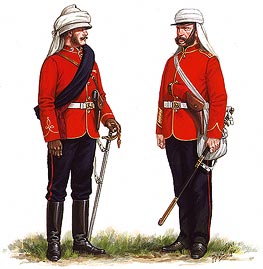 |
| Company Officer 31st and Sergeant Major of The Queen's in Forage Cap. |
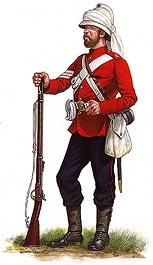 |
| Sergeant of The Queen's. |
Both The Queen’s (Second) Royal Regiment and the 31st (Huntingdonshire) Regiment became involved in the Chinese War and the Anglo-French Expeditionary Force of 1860. The aim of the allies was to compel the Chinese court at Peking to observe the trading treaties signed between their governments at Tientsin in 1858. Lieutenant-General Sir Hope Grant was the British commander with de Montauban in charge of the French; in theory, they were supposed to take charge of their force on alternate days!
Both Regiments were in Major-General Mitchell’s 1st Division, with the 31st (Huntingdonshire) Regiment in Brigadier-General Staveley’s brigade and The Queen’s (Second) Royal Regiment of Foot in Sutton’s 2nd Brigade. On 30th July 1860, Sutton’s Brigade landed at Pei Tang-Ho and so 200 Queensmen and 200 French soldiers became the first allied troops ashore. A few days later a reconnaissance force moved towards the Taku Forts and two Queen’s soldiers were wounded by bullets from a Chinese jingal (a huge musket crewed by three men). The 31st were involved in the move towards the emplacement at Tang–Ku and the preparation of a shelter trench; the Queen’s took part in the eventual assault. Two of the Regiment’s soldiers were wounded; 100 Chinese were killed and forty-five guns were captured. The allied force then went on to capture the remaining Taku Forts after a break of six days. These second assaults were led by the 2nd Division.
The Chinese War finished with the allied occupation of Peking on 13th October 1860 and the Chinese acceptance of the trading treaties. Afterwards, the Queen’s were transported to England via Hong Kong, while the 31st went on garrison duty at Tientsin.
Conditions were very unpleasant during this campaign. The Taku Forts area was surrounded by liquid mud and swampland with deep water courses intersecting it in all directions. General Grant stated that “It is simply a matter of the degree of filth our men must traverse”. For part of the advance, 1st Division Headquarters was under a foot of water. Standards of uniform, therefore, varied and there were few distinctions between officers and men on the ground.


Related
