Recruiting in the 18th & 19th Centuries
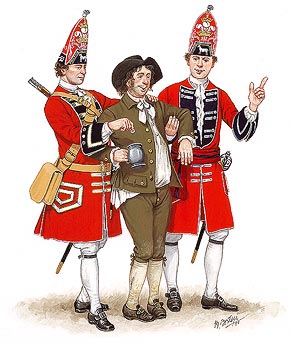 |
| Sergeant and Grenadier of the Princess of Wales's Regiment of Foot, on recruiting duties 1714 - 27. |
The British Army has always had the tradition of being a volunteer service, as it is today; conscription did not begin until 1916 and then there was a further break of volunteer service until Conscription and National Service during the Second World War and up to 1961. Unfortunately, despite the successes of the Army and our Regiments in battle, soldiering had a bad reputation. Consequently, recruits of the 18th and 19th centuries tended to be men who needed shelter from civilian life or those who were forced into it by poverty and starvation. It is no surprise that the Duke of Wellington called soldiers “the scum of the earth”!
Recruits had to be attracted to join the Regiments. Groups of soldiers were sent by battalions to markets, fairs and public houses as recruiting parties. They were sanctioned by a Beating Order and often consisted of an officer, one or two sergeants, a drummer and four or five private soldiers. The drummer beat his drum to attract interest, whilst the smart soldiers would carry bunches of ribbons or “recruiting favours”, which could be given to each man as he enlisted. Recruiting posters were also carried, but had to be read out loud, due to general illiteracy amongst the potential clients!
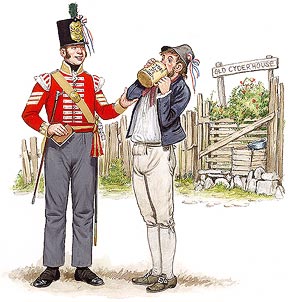 |
| Sergeant Light Company 31st (Huntingdonshire) Regiment, 1810. |
A number of deceptions were tried by the recruiting sergeants, who could earn good money (£1 11s 6d per man) for their efforts. Men were offered adventure and possibly an escape from their civilian toil or ties. Riches and rapid promotion were also exaggerated, along with the prospect of excellent food and a commission within a few months. Tricks for enlistment were also tried and the reason that some pint mugs have glass at the bottom was to avoid accidentally quaffing the beer without looking first, thereby “taking the King’s shilling”!
The biggest inducement to joining was the cash bounty; this amounted to £23 17s 6d for lifetime service in 1812, when there was an urgency for recruits. Unfortunately, few recruits reached their battalion with the money still in their pockets, as the recruiters had often found some way of removing it! Many would-be recruits accepted the bounty money and then immediately deserted; this became known as “pear making”.
Despite all of the hardships, most recruits joined willingly and probably found military service no worse than what they could expect in civvy street!

Related
